
Circuit Innovations
Taking your electronics ideas and turning them into reality
| Home |
| Design Service |
| Kits and Products |
| Film and Television |
| Beginners Corner |
| Surplus Stock |
| Price / Ordering Info |
| Contact Us |
| Terms and Conditions |
| Links |
| About |
|
Circuit Innovations 24 Leasmires Avenue Easingwold York. YO61 3DU UK |
 |
| Beginner's Corner > Components > Resistors |
|
Resistors are to be found in almost every circuit and appear in many shapes and sizes. The most commonly used types for the hobbyist are the axial lead variety with power ratings up to 1W. The unit of resistance is the ohm which is represented by the letter omega W and is named after the German scientist Georg Simon Ohm. An ohm is defined as the resistance of a conductor in which a current of one amp causes a potential difference of one volt across its terminals. In other words V = IR where V is the potential difference in volts, I is the current in amps and R is the resistance in ohms. The more commonly used SI notation for ohms (mainly because omega isn't easily found on the keyboard) is to use R. For example, 10W is written as 10R, 4700W is equivalent to 4.7KW and is written as 4K7 where the K replaces the decimal point and represents 1000. 560,000W is written as 560K and 1,000,000W is written as 1M0, where the M represents 1 million. A brief description of various types of resistor is shown below.
Some of the smaller resistors use a completely different system of numbers and letters to denote the value, know as the EIA-96 standard. This system uses a 3-digit code where the first pair of numbers denote the three most significant digits of the value and the final character of the code, usually a letter, denotes the multiplier. To complicate matters even further, some SMD resistors don't have any markings at all or are so small that marking them would be impossible.
|
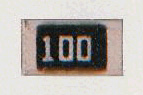 Let's start with the smallest. The picture shows a typical surface mount resistor. These resistors aren't used very much by the hobbyist although anyone attempting to repair a commercial product will probably find vast numbers of these. SMD resistors are available in a number of sizes, the largest being around 4mm x 2mm. The component value is marked on the side of the package. The first two (or three) digits give the first numbers of the value and the final digit gives the multiplier. In the example shown here, the value isn't 100 ohms as you may have thought, but it is in fact 10 ohms. Low value resistors such as this are also sometimes marked as 10R. Another example, a resistor marked 472 has a value of 4700 ohms or 4K7. The 2 is the multiplier and refers to 10 to the power of 2 or 100, so the 47 is multiplied by 100 to give 4700.
  The more commonly used axial lead resistor is available in a range of power ratings from around 0.125W up to 3W. The low power resistors are usually made from carbon or metal film and the higher powers are made from metal oxide. The carbon range has largely been superseded by the metal film range which gives better stability and higher tolerances. The resistor value is marked using a series of coloured bands.
 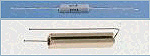 Wirewound resistors are normally used for higher power dissipation. As their name suggests, they consist of a length of resistance wire wound around a former. The outside of the resistor may be coated with silicone, vitreous enamel or a ceramic material.
 For really high power dissipation, the wirewound resistor is mounted inside a cast aluminium shell. The shell usually has a flat surface and fixing holes at one side so that the resistor may be fastened down to a suitable heatsink to help to remove the heat. These resistors are available in power ratings from 10W to 300W and even a water-cooled 600W version!