
Circuit Innovations
Taking your electronics ideas and turning them into reality
| Home |
| Design Service |
| Kits and Products |
| Film and Television |
| Beginners Corner |
| Surplus Stock |
| Price / Ordering Info |
| Contact Us |
| Terms and Conditions |
| Links |
| About |
|
Circuit Innovations 24 Leasmires Avenue Easingwold York. YO61 3DU UK |
 |
| Beginner's Corner > Components > Diodes |
|
The diode is one of the simplest forms of semiconductor, consisting of only one PN junction. The P and N refer to the two types of silicon (or germanium) used in the construction. These types are formed by taking the pure material and doping it by adding an impurity which either makes the material more positive or more negative depending upon the impurity used. The two terminals of the diode are known as the anode and cathode. The diode may be regarded as a one way valve to the flow of electric current. Current flowing from anode to cathode flows with ease but current flowing from cathode to anode is blocked. In reality the diode isn't a perfect valve. There will be a very small current flow when the diode is supposed to be blocking current. This is known as the reverse leakage current and is usually extremely small. The diode can only hold back a certain amount of current, in the same way that a water valve can only hold back a certain amount of pressure. The limit to this amount is known as the reverse breakdown voltage. Attempting to use the diode above this voltage will usually result in its destruction.
Schottky Barrier Diode. This type of diode was invented , and named after, Walter H. Schottky as was created to reduce the forward voltage drop of a typical PN junction diode. This is especially useful in power supply circuits where the rectifier diodes may need to handle a large current but with minimal voltage losses in order to maintain a high efficiency and minimal heat production. The diode differs from the conventional PN diode in that instead of using two differently doped semiconductor materials, it uses a metal for the anode and an N-type semiconductor for the cathode. This gives a much lower forward voltage drop and high switching speeds which are beneficial for modern switch-mode power supplies. Zener Diodes
|
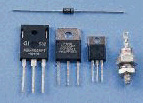 The diode also isn't perfect in the forward conduction direction. When passing a current from anode to cathode, there will be a small voltage drop across the PN junction. This is typically around 0.7v for silicon diodes and around 0.4v for germanium diodes. This is why germanium diodes often still appear in low level audio circuits and similar items even though silicon is a far superior material in terms of thermal stability and reliability. The forward voltage drop of the diode must be taken into account when using it as a rectifier in high current circuits. The voltage drop will cause a loss of efficiency in the circuit and will also cause a build up of heat in the diode. This is why many rectifier diodes are designed to be bolted onto heatsinks.
 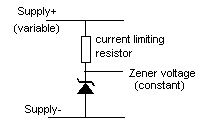 The zener diode must be mentioned specifically while passing. This device makes use of the reverse breakdown of the diode. Under normal circumstances the reverse breakdown occurs at a specific voltage and usually results in a large flow of current and the destruction of the diode. The zener diode makes use of this feature and provided that the current is limited, usually survives to tell the tale! The zener diode is particularly useful in circuits where a relatively constant voltage reference is required. In the circuit shown, the voltage across the zener diode remains constant even though the supply to it may be varying.