
Circuit Innovations
Taking your electronics ideas and turning them into reality
| Home |
| Design Service |
| Kits and Products |
| Film and Television |
| Beginners Corner |
| Surplus Stock |
| Price / Ordering Info |
| Contact Us |
| Terms and Conditions |
| Links |
| About |
|
Circuit Innovations 24 Leasmires Avenue Easingwold York. YO61 3DU UK |
 |
| Beginner's Corner > Components > Capacitors |
|
Capacitors are widely used in electronic circuits and appear in many different shapes and forms. The capacitor essentially consists of two metal plates separated by an insulating material known as the dielectric. The dielectric can be anything from air to paper to plastic materials. The operating characteristics and value determine the materials used. The value of the capacitor is proportional to the area of the two metal plates and is inversely proportional to the distance between them. In other words, a large value capacitor will have large plates separated by a very thin dielectric layer. The unit of capacitance is the Farad, represented by a capital F and named after Michael Faraday. The Farad is actually quite a huge unit so it is more common to find capacitor values quoted in micro-farads (1 millionth), µF. It is important to remember this when performing calculations and to remember to calculate in Farads and not micro-farads, otherwise your answers will be a million times to big or too small! As well as selecting the correct capacitance it is also important to be aware of the working voltage of the capacitor. This is the maximum voltage that the dielectric can safely withstand without breaking down. Operating the capacitor above its maximum working voltage will result in the insulation failing and the capacitor plates shorting together. This fault may produce quite explosive results. Capacitor Types Capacitors can be divided into two main categories, polarised and non-polarised. As their name suggests, the polarised types must be connected with the correct polarity.
The two main types are shown in the picture above left. The axial type, where the component leads emerge from both ends of the body are largely being replaced by the radial types where both leads emerge from the same end. These capacitors are polarised and must be connected the correct way round. Fortunately the manufacturers provide us with plenty of ways of identifying the positive and negative leads. Usually there is a stripe on the side of the capacitor body which points to the negative lead. On axial components the positive end is shown by a narrow collar on the body. On radial components the positive lead is usually longer than the negative one. Most electrolytic capacitors also contain safety devices to minimise the danger when connected with reverse polarity. The smaller capacitors have the end caps made from two or more sections with a join between them. If the capacitor is connected backwards or used above its rated voltage the dielectric layer inside the capacitor will be destroyed resulting in a rapid build up of heat and pressure. The join on the end cap will then give way and allow the pressure to be released in a cloud of boiling chemicals. This is one very good reason not to lean over the top of a faulty circuit to see why it isn't working! The larger capacitors are fitted with a small rubber plug on the base which pops out to release the pressure. Some of the smaller types don't have any pressure relief mechanisms at all and will just explode violently, so be careful.
|
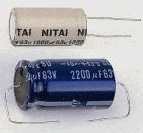 Aluminium Electrolytic These capacitors are quite commonly used and are available in a wide range of values and working voltages. They typically provide a large value of capacitance in quite a small package and are commonly used as smoothing or reservoir capacitors in power supply applications. The only main drawback is that the capacitor value can have quite a large range of tolerances, typically +/- 10 or 20%They are constructed from two layers of aluminium foil separated by a chemical compound and then rolled up to form a smaller package. The voltage applied to the capacitor causes the dielectric chemical to form a thin insulating layer on the aluminium foil. Reversing the applied voltage will cause the insulating layer to be destroyed along with the capacitor.
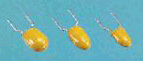 Tantalum Bead These capacitors are also polarity sensitive. They provide quite large values of capacitance in a very small package. They usually provide higher tolerances and lower leakage currents than aluminium electrolytics. The body of the capacitor is usually marked with a stripe and a + to show the positive leg.
 Non-Polarised Types There are many different types of non polarised capacitor. The exact construction and materials used depends upon the type of application that the capacitor is being designed for. The choice of materials can affect the tolerance of the capacitor and its stability over a wide range of operating conditions. This may be a critical factor when designing tuned circuits or oscillators, for example.
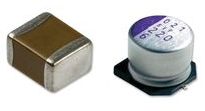 Surface Mount Polarised and non-polarised capacitors are also available in surface mount packages in several different case styles and sizes..